
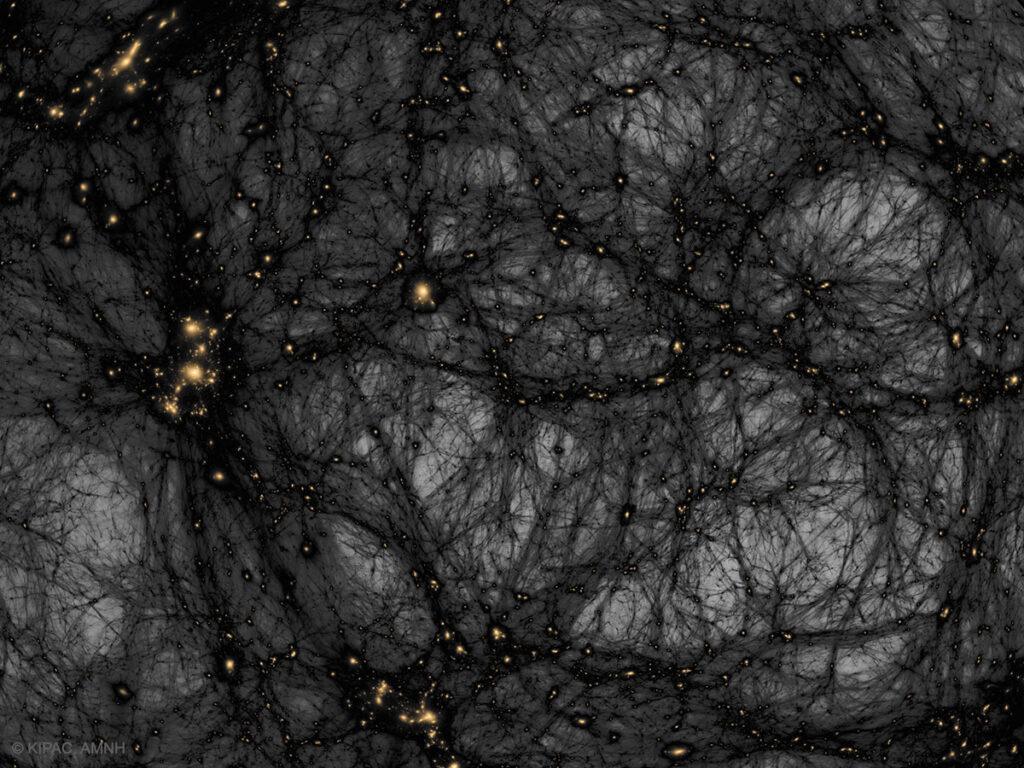
The image depicts a computer-generated simulation illustrating the distribution of matter within our universe. In this representation, dark matter is indicated by a dark hue against a lighter backdrop, highlighting its pervasive yet elusive nature.
Understanding Dark Matter in Cosmic Structure
Dark matter plays a crucial role in the formation and evolution of cosmic structures. Although it cannot be observed directly through conventional means, its presence is inferred from gravitational effects on visible matter. This simulation effectively captures the intricate web of dark matter that underpins galaxies and clusters, providing insight into the cosmic architecture.
Researchers utilise such simulations to better comprehend how dark matter influences the motion of galaxies and the overall structure of the universe. The darker regions in the simulation signify areas with a higher concentration of dark matter, which are thought to act as gravitational wells, attracting ordinary matter and facilitating galaxy formation over billions of years.
The Significance of Computer Simulations
Computer simulations are invaluable tools in astrophysics, allowing scientists to model complex phenomena that are otherwise challenging to observe directly. By manipulating various parameters, astrophysicists can explore different scenarios of cosmic evolution and examine the role of dark matter in shaping the universe.
These simulations not only enhance our understanding of dark matter but also provide a framework for testing theoretical predictions against observational data. As technology progresses, the accuracy and detail of these simulations continue to improve, offering increasingly refined insights into the universe’s mysterious components.
Future Research Directions
As research into dark matter advances, scientists are focusing on identifying its fundamental properties. Various hypotheses suggest that dark matter may consist of exotic particles or that it could interact with regular matter in ways yet to be fully understood. Future studies will aim to bridge the gap between theoretical models and empirical evidence, potentially leading to groundbreaking discoveries about the universe’s composition.
Continued exploration in this field promises to unlock further mysteries of the cosmos, enhancing our grasp of how dark matter influences galactic formation and the large-scale structure of the universe. As we delve deeper into these cosmic enigmas, the picture of our universe becomes ever more intricate and fascinating.



More Stories
NASA’s Artemis III Mission Set to Trial Future Moon Lander Operations
Discover Rosetta’s Stunning Selfie: A Cosmic Capture from October 24, 2026
NASA and Partners Fast-Track Lunar Lander Development for 2028 Moon Missions