
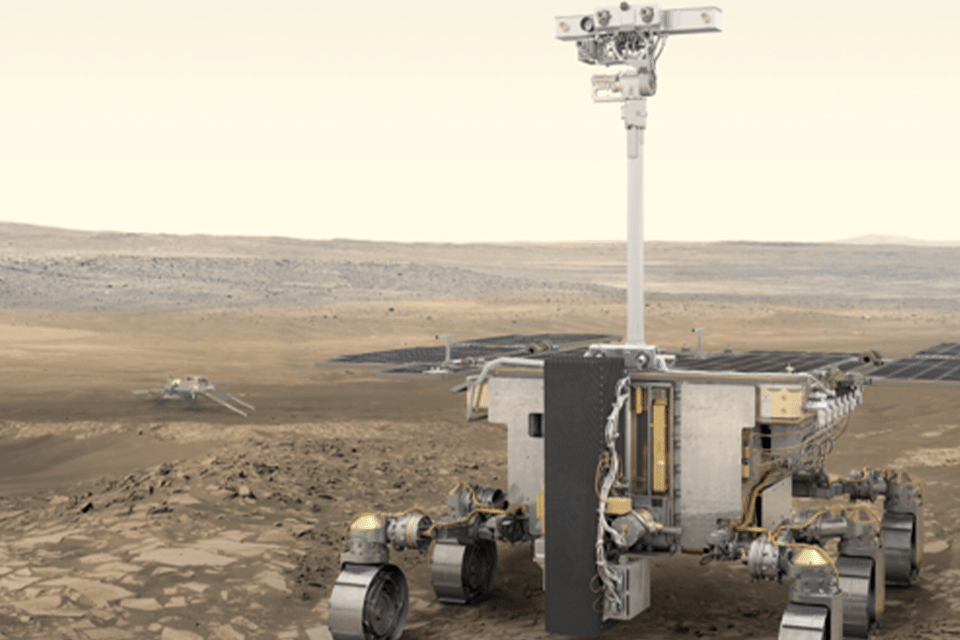
The ExoMars mission poses one of humanity’s most fascinating inquiries: has life ever existed beyond our planet? To explore this question, the European Space Agency (ESA) has developed the ExoMars programme, consisting of two interconnected missions aimed at studying Mars from both orbit and the planet’s surface in the near future. Currently, the Trace Gas Orbiter (TGO) is in orbit around Mars, analysing its atmospheric composition, while the Rosalind Franklin rover is set to delve into the Martian surface.
These missions aim to uncover critical information about Mars, including its geological composition, the evolution of its environment, and the potential for past or present life. The data collected will also support broader research into Martian chemistry and environmental conditions, which is essential for assessing the feasibility of future human exploration of Mars.
Understanding Mars through the Trace Gas Orbiter
The Trace Gas Orbiter commenced its mission in 2016 and began scientific operations in 2018. It has since transmitted more data than all previous Mars orbiters combined, including an impressive 13 million square kilometres of multispectral imagery. The TGO continues to monitor the Martian atmosphere using four advanced scientific instruments to detect trace gases, aiding scientists in bridging the knowledge gaps about the planet and assisting in the planning of future missions.
Among its objectives, the TGO has been particularly focused on the detection of methane, a gas previously identified by ESA’s Mars Express mission in 2003. Methane is significant as, on Earth, it is associated with both biological and geological processes. Identifying and understanding methane on Mars could provide insights into the planet’s geological activity and its historical conditions for life. Although TGO has yet to record any methane, it has made other notable discoveries.
For instance, the orbiter detected hydrogen chloride in the Martian atmosphere, offering new insights into the planet’s chemical processes and water cycle. Such findings are crucial for understanding Mars’ transformation over time, the challenges its surface poses for future missions, and what preparations may be necessary for robotic or human exploration.
Additionally, TGO has identified water-ice at lower latitudes, a discovery that holds great promise for future explorers. Water is an invaluable resource that could be converted into breathable oxygen, fuel for spacecraft, and drinking water for astronauts. The presence of accessible water-ice could significantly enhance the practicality of upcoming missions to Mars.
A further advantage of TGO is its CASSIS camera, which produces high-resolution images of the Martian landscape. This capability not only allows for stunning vistas of Mars but also aids in preparing for future landings, including the upcoming Rosalind Franklin rover mission. High-resolution imaging is essential for ensuring safer landings and more effective mission planning.
Exploring Mars with the Rosalind Franklin Rover
While the TGO focuses on atmospheric observations, the Rosalind Franklin rover is designed to investigate the Martian surface for signs of environments that may have once supported life, or may still do so today.
As the first European rover to traverse Mars, Rosalind Franklin boasts the unique ability to drill to depths of two metres below the surface to collect samples. Extracting samples from beneath the surface offers better protection against the harsh radiation that affects surface soil. The rover’s onboard laboratory will analyse the mineral and chemical composition of these samples in the quest for evidence of past or present life.
The mission is set to land in the Oxia Planum region of Mars, an area characterised by ancient, clay-rich rocks that are approximately 3.9 billion years old. Clay minerals typically form in the presence of water, making this landing site particularly promising for discovering evidence that Mars may once have had conditions favourable for life.
The UK’s Significant Contribution to ExoMars
The United Kingdom plays a pivotal role in both components of the ExoMars programme, contributing to funding, engineering, research, and mission operations. This involvement underscores how UK expertise is integral to answering a question that captivates people worldwide.
Over the past two decades, the UK has invested approximately £490 million in the ExoMars initiative, which has supported more than 200 skilled jobs in the country. Additionally, 31 UK scientists are named as instrumental team members for the mission, while over 100 further UK scientists are engaged in various aspects of the programme.
This support is instrumental in financing the science, engineering, and technology that underpin the mission, encompassing everything from constructing the spacecraft and its instruments to analysing the data and delivering high-calibre scientific results.
The Rosalind Franklin rover is currently being assembled by Airbus Defence and Space at its facility in Stevenage, UK.
Honouring Scientific Legacy
Named after the pioneering UK scientist Rosalind Franklin, whose work was fundamental in elucidating the structure of DNA, the rover’s name links the mission’s search for life on Mars with a scientist whose discoveries have profoundly impacted our understanding of life on Earth.
The rover is equipped with a suite of scientific instruments, each designed for specific tasks. Together, they will enable the rover to select which rocks to examine, analyse their chemical properties, and create a comprehensive picture of the Martian environment.
Numerous UK academic institutions contribute to the rover’s instruments, showcasing the collaborative effort behind this ambitious mission. The PanCam, a panoramic camera system, is led by scientists from University College London’s Mullard Space Science Laboratory, in collaboration with Aberystwyth University, Birkbeck College, and the University of Leicester. This camera will capture detailed images of the Martian surface, facilitating the creation of 3D maps to inform drilling decisions.
In addition, the University of Leicester, Bradford University, and the Science and Technology Facilities Council’s Rutherford Appleton Laboratory are key collaborators on the Raman Laser Spectrometer, an instrument capable of identifying minerals and chemical compounds in Martian samples, including potential biomarkers that may indicate the presence of past or present life.
Furthermore, Aberystwyth University, in conjunction with MSSL, STFC RAL, and Qioptiq Ltd, is developing the infrared spectrometer called Enfys, which translates to ‘Rainbow’ in Welsh. This instrument will enhance the analysis of the rock materials, aiding in determining optimal drilling locations for sample collection.
Future Endeavours and Mission Timeline
In early 2026, NASA approved the Rosalind Franklin Support and Augmentation project, known as ROSA, which will provide essential hardware and services for the mission. NASA has also selected SpaceX’s Falcon Heavy rocket for the rover’s launch from Kennedy Space Center.
Currently, the launch is scheduled for late 2028, with an anticipated landing on Mars in 2030. The developments surrounding the ExoMars missions continue to generate excitement and anticipation as humanity edges closer to answering the age-old question of life beyond Earth.


More Stories
Security Minister Delivers Insightful Address at International Security Expo 2023
Exciting New Appointments Announced for the Financial Conduct Authority Board in 2026
DIA and MHRA Unveil Exciting Speaker Line-Up for Inaugural Global Summit 2023