
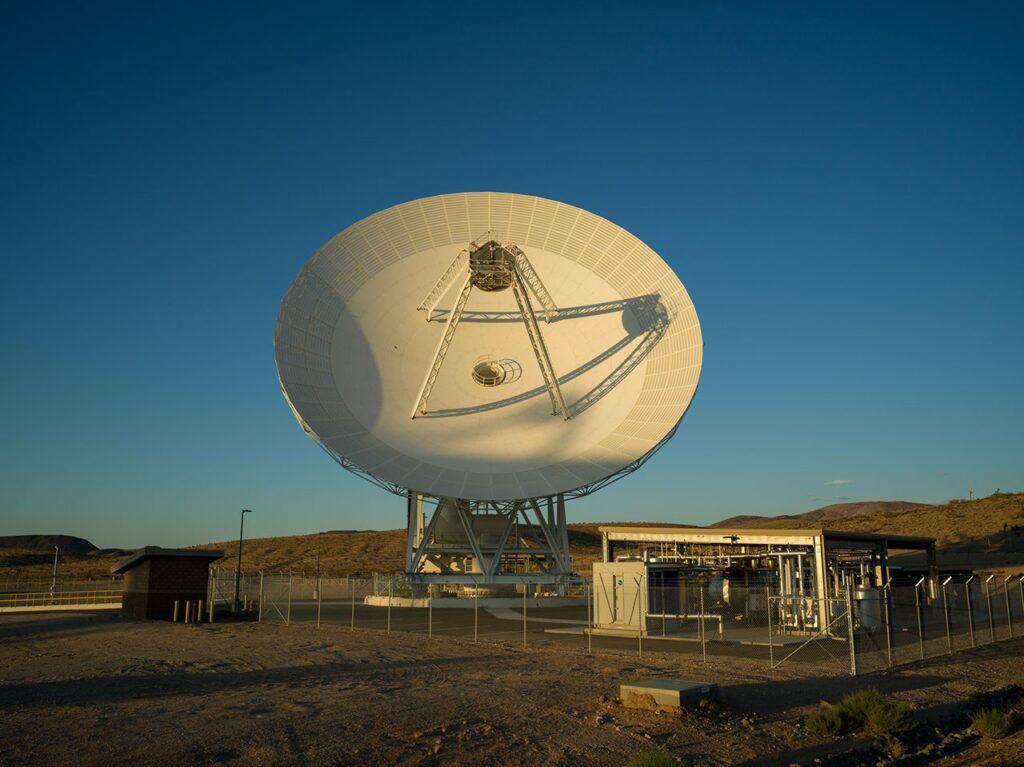
A striking white satellite dish antenna dominates the landscape of a vast desert plain, set against a backdrop of a clear blue sky. The structure, illuminated by the warm rays of the sun, is accompanied by several smaller facility buildings that form part of the installation.
Long shadows stretch across the ground, a testament to the recently inaugurated Deep Space Station 23, which is situated within the Goldstone complex of the Deep Space Network, located near Barstow, California. This installation, completed in August 2026, represents a significant advancement in our capabilities for interstellar communication.
A Leap Forward in Space Communication
The completion of Deep Space Station 23 marks a pivotal moment in the evolution of space exploration. Serving as a vital link in the communication chain between Earth and various exploratory missions, this facility is equipped with cutting-edge technology designed to facilitate contact with spacecraft venturing into the far reaches of our solar system and beyond. The immense size of the antenna allows for the reception and transmission of signals over vast distances, ensuring that data from distant missions can be effectively relayed back to mission control.
This new station is part of a broader initiative to enhance the Deep Space Network, a global array of antennas that support interplanetary spacecraft. As the demands for communication grow with increasing missions to Mars, the Moon, and potentially further afield, the addition of such a facility is crucial.
Strategic Location and Technological Advancement
Positioned strategically in the arid landscape of California, the Goldstone complex benefits from minimal interference, allowing for clearer signal reception. This factor is essential for the operations of the Deep Space Network, where precision in communication can significantly impact the success of missions. The advancements in technology embedded within Deep Space Station 23 further enhance its capabilities, ensuring that it can handle the complexities of modern space missions.
The facility’s design reflects a commitment to both functionality and resilience, prepared to face the challenges of the harsh desert environment while remaining operational for years to come. As space exploration enters a new era, the establishment of such facilities is paramount for continuing humanity’s quest for knowledge beyond our planet.



More Stories
Inaugural Ceremony for NASA’s Deep Space Station 23: A Milestone for the Deep Space Network
President Bestows Prestigious US Space Award on NASA’s Artemis II Crew
NASA Announces Inaugural Winner in Phase 2 of the Exciting LunaRecycle Challenge