
Exploration of Neptune by Voyager 2
Embark on a journey through the cosmos! Each day offers a unique image or photograph of our captivating universe, accompanied by a concise explanation crafted by an expert in astronomy.
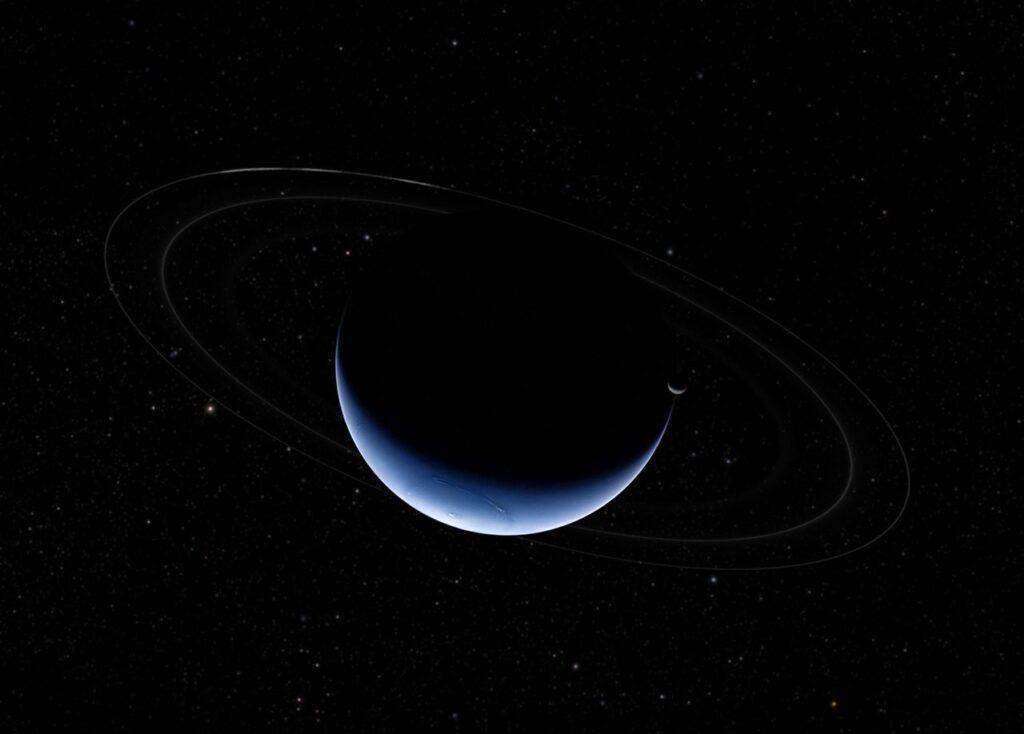
Voyager 2, while navigating the outer solar system, achieved its closest approach to Neptune on 25 August 1989, marking it as the sole spacecraft to explore this remote ice giant planet. The stunning visuals captured during its close encounter and the subsequent days have culminated in a remarkable composited scene showcasing the dim outer planet, its largest moon Triton, and the delicate system of rings surrounding them.
From a vantage point just beyond Neptune’s orbit, this perspective gazes back towards the Sun, revealing Neptune and Triton as slender, sunlit crescents. Cirrus clouds and a dark band encircle Neptune’s southern polar region, with a swirling vortex observed above the pole itself. Voyager’s fly-by provided the first images of the faint ring system, along with the three prominent ring arcs, although the most delicate segments are artistically represented in this composited image.
The background starfield, spanning 7.5 degrees, is derived from sky survey data centred on the constellation Camelopardalis, aligning with the outbound Voyager’s view of the impressive Neptunian system. Currently, in 2026, the Voyager 2 spacecraft continues its voyage in interstellar space.
Upcoming Image: Swirling Phenomena
Date: 21 November 2026
Credit & Copyright: Assembly/Processing by Rolf Olsen, Data from Voyager 2 and NASA Planetary Data System.
This initiative is supported by the ASD at NASA/GSFC and NASA Science Activation in collaboration with Michigan Tech University.
Previous Image Review
Yesterday’s Image featured: APOD – 20 November 2026 – V-G-R.
Stay tuned for tomorrow’s intriguing image!




More Stories
Discover the Stunning Dark Nebula Lynds 1251: A Cosmic Marvel Unveiled on 23 November 2026
Stunning Swirls and Vibrant Colours of Jupiter Captured by Juno – 22 November 2026
Curiosity Mars Rover Successfully Gathers Valuable Samples for Scientific Research