
Exploring the Horsehead and Flame Nebulas
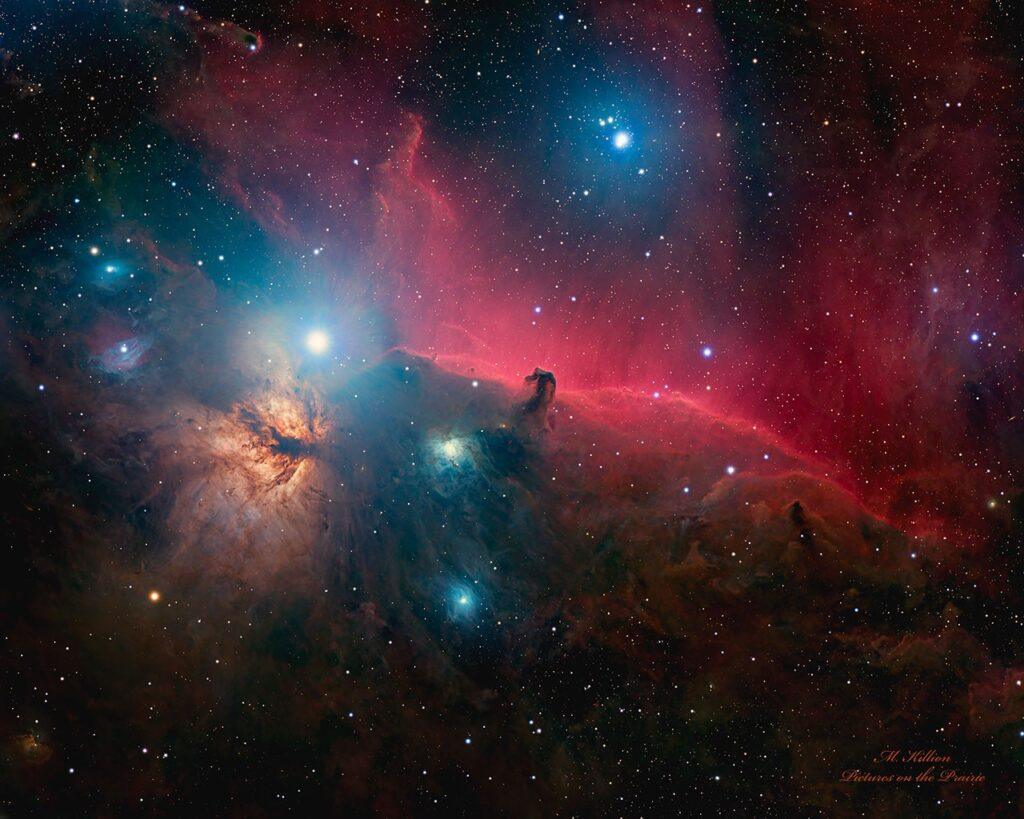
Today’s captivating image could easily be mistaken for a work of art. The vibrant colours depicted in this photograph reveal intriguing aspects of our universe. The prominent blue star, located to the left of the centre, is Alnitak, a member of a triple star system renowned for being the easternmost star in Orion’s Belt. At the heart of the image lies the unmistakable silhouette of the Horsehead Nebula, aptly named for its resemblance to a horse’s head. This nebula spans approximately five light-years in height and is situated around 1,500 light-years from Earth.
Composed primarily of dust and gas, the Horsehead Nebula obscures the red glow emanating from behind it. This glow is produced by hydrogen gas that is being ionised by the bright star Sigma Orionis, which is positioned at the top of the image. To the left, one can observe the Flame Nebula, characterised by its orange hue and dark filaments. Additionally, in close proximity to the Horsehead Nebula, the blue reflection nebula NGC 2023 is actively forming new stars.
Behind the Scenes of Astrophotography
The remarkable data used to create this visually stunning image were gathered over a duration of nearly six hours at the Utah Desert Remote Observatories. Notably, the astrophotographer operated the equipment remotely from his residence in Illinois, situated more than 2,000 kilometres away. This blend of advanced technology and artistic vision allows the beauty of the cosmos to be captured and shared with a wider audience.
What Awaits Tomorrow
With anticipation, we look forward to the next image that will be unveiled tomorrow, continuing our journey through the wonders of the universe.




More Stories
Stunning Swirls and Vibrant Colours of Jupiter Captured by Juno – 22 November 2026
Voyager’s Stunning Neptune Encounter: A Deep Dive into the Cosmos on 21 November 2026
Curiosity Mars Rover Successfully Gathers Valuable Samples for Scientific Research