
Exploring the Night Sky
Embark on a journey through the cosmos with a daily showcase of captivating images or photographs that highlight the wonders of our universe. Each image is accompanied by a concise explanation crafted by an expert in the field of astronomy.
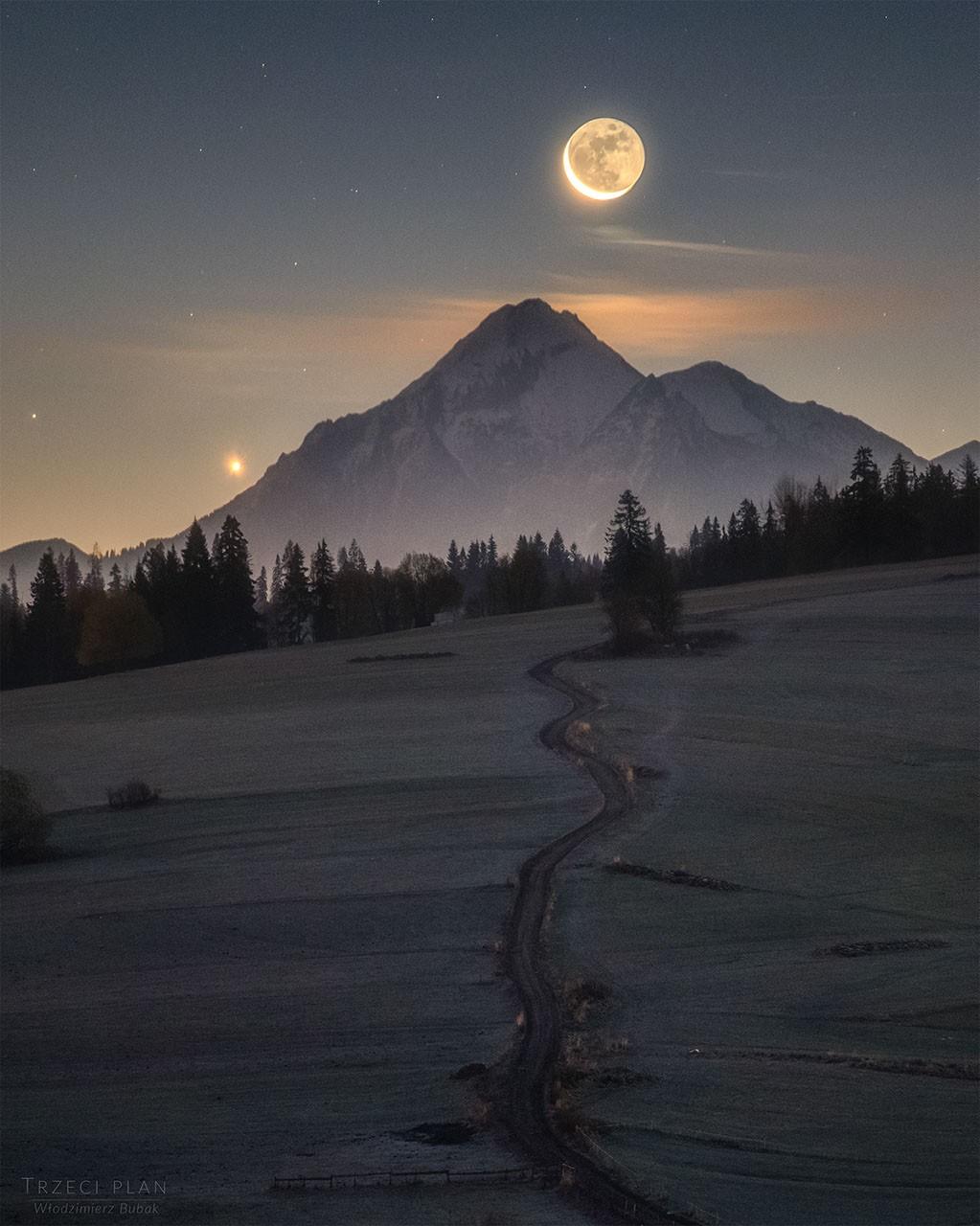
A Celestial Gathering of Moon, Venus, and Spica
The phrase “not all those who wander are lost” aptly reflects the nature of the night sky, where planets are known to wander across the celestial sphere. The term “planet” itself originates from the Greek word for “wandering star.” As these celestial bodies shift in relation to fixed stars, they can appear to draw nearer to other astronomical objects, resulting in what are known as conjunctions. These occurrences are not mere coincidences; they adhere to the precise principles of celestial mechanics.
This serene image, captured in Poland, presents the crescent Moon gracefully positioned above the Tatra Mountains, with the brilliant planet Venus located slightly lower on the horizon. To the left of Venus, the bright star is Spica, found within the constellation of Virgo, also known as the Maiden. Spica ranks among the brightest stars observable in the night sky, situated approximately 250 light-years from Earth. In 1890, it was discovered that Spica is a binary star system, consisting of two massive blue stars that orbit one another every four days. However, recent reports indicate that Spica, currently accompanied by the wandering Venus, is actually part of a triple star system.
Anticipation for Tomorrow’s Image
As we look ahead to the future, the excitement builds for what tomorrow’s celestial image will reveal.
Date: November 12, 2026
Previous Image: NGC 4449: Small Galaxy, Big Impact (November 11, 2026)




More Stories
Stunning Swirls and Vibrant Colours of Jupiter Captured by Juno – 22 November 2026
Voyager’s Stunning Neptune Encounter: A Deep Dive into the Cosmos on 21 November 2026
Curiosity Mars Rover Successfully Gathers Valuable Samples for Scientific Research